Showing posts with label Musical Theatre. Show all posts

Tuesday, July 9, 2019

Martinizing History - the Story of a Poster


NYPL poster - click to enlarge.
I was recently offered what was believed to be an original poster from the 1903 Broadway Wizard of Oz musical (see below). As a plus, this poster had come from the OzCot Lodge owned by Harry Baum (L. Frank's son) and Harry's wife, Brenda. What fun provenance! From the seller's description I thought it was going to be another copy of a well-known Wizard of Oz poster at the New York Public Library (seen at left). Indeed, I've had a black-and-white photocopy of the NYPL poster for over twenty years, which used to hang in my studio in San Diego. Oddly, the poster I'd been offered was mounted to a piece of green-painted plywood with a wooden frame around it. Hmm... that's kind of curious.

The original NYPL poster is quite large - approximately a foot wide and about four feet long. This poster has been reprinted in a number of scholarly publications. It is reproduced in Mark Evan Swartz's Oz Before the Rainbow (2000) and in Allan Eyles's The World of Oz (1985). It is an interesting poster, being essentially line art printed in green on white paper. A little more color was added by printing two boxes of type in red and adding red fields of color behind the portraits of the Scarecrow, Tin Woodman, and Dorothy at the top. The words "WIZARD OF OZ" are printed in overlapping green and red resulting in a rather unattractive brown color. The poster is also very time specific. Directly under the words "WIZARD OF OZ" it says "Now in its 23d Week of Phenomenal Success."

Although the poster I was recently offered (see below) is identical in size to the NYPL poster, it has several oddities. The first is that it was printed in black and white, NOT green and white with red enhancements. Well, I reasoned . . . maybe the show's producers decided to print this poster more cheaply as the show progressed in its run after "its 23d Week of Phenomenal Success."


The Poster that was offered for sale.

I asked the owner of the poster (and long time Oz Club member) Mark Frederic Dereng for a more detailed photo and on receipt found a most curious thing. The black-and-white poster had exactly the same date as the green-and-white NYPL original: "Now in its 23d Week . . ."

Detail of the poster that was offered for sale. Courtesy of owner Mark Frederic Dereng.

Why? Why on earth would the producers have produced a green, red, and white version AND a black-and-white version for the same week of advertising?  I noticed that there was another significant difference between the two posters. The NYPL version has the names of the characters printed in a typeface similar to "Courier." It looks a lot like a typewriter font. It's actually rather ugly and the lettering is crooked in places and is a detriment to the NYPL poster. The offered black-and-white poster had the character names hand-lettered as white text against a black background.

Character Lettering from original NYPL Poster.
Character Lettering from black-and-white version.

The ABC version.
On the one hand, the white-on-black lettering seems an improvement of the boring and ugly typeface of the NYPL poster. On the other hand, the new lettering got me kind of worried, as it really looked a lot like Oz illustrator Dick Martin's lettering. It is also forced in places - such as the crude way the black wraps around Sir Dashemoff's foot. Hmmm . . .

This poster is said to have belonged to Baum's son, Harry. Could that be confirmed? I asked friends who had attended the old OzCot conventions in the 1960s if they recalled the poster being at OzCot. One long-time friend quickly replied: he had first seen the poster in the December 1962 issue of American Book Collector and then on exhibit at OzCot in 1963. He attached high-res scans of the poster from the magazine. (The American Book Collector version of the poster can be seen at right - click to enlarge.) They matched the poster I had been offered. The poster's provenance as belonging to Harry Baum was now verified.

I received several phone camera photos of the poster I had been offered. In every way the photos match the American Book Collector version of the poster.

But that black-on-white lettering really looked so Dick Martin-like! And Dick helped procure the graphics for the 1962 American Book Collector. Had Dick modified the poster for reproduction in the American Book Collector and then, perhaps, given his photostat to Harry Baum to adorn the Ozcot Lodge? My friend had verified that the poster was at Ozcot by June 1963 - but had Harry Baum owned the poster for sixty years or six months?

As I mentioned up above, once that lettering started shouting Dick Martin, the entire history of the poster became suspect to me. You see, Dick Martin often tweaked, altered (and sometimes completely invented) graphics back in the late 1950s and '60s, usually to make them reproduce more easily.

Below is an example of a 1903 Wizard of Oz poster Dick Martin "invented." It is printed in The Musical Fantasies of L. Frank Baum (1958). The Tin Woodman and Scarecrow drawings are Dick Martin trying to be Denslowesque. The poster is based on nothing I have ever found in my very in-depth research into the show.

Dick Martin's poster from MUSICAL FANTASIES OF L. FRANK BAUM.
To top it off, Dick Martin pulled the photos of Montgomery and Stone from the cover of their Chin-Chin sheet music circa 1914!

Sheet Music from CHIN-CHIN (1914).

But let's look at Dick Martin's lettering on his "invented" poster:

Dick Martin lettering circa 1958.

It is very similar to the white on black lettering of the poster I was offered. Using letters from Dick Martin's invented poster from Musical Fantasies, I pieced together most of a name to use for comparison. I chose General Riskitt as an example, as he has more letters in common than the other names:


In my opinion the clear similarity in lettering style clinches it. The black-and-white version of the poster I was offered seems to have been heavily modified by Dick Martin. It is, in my opinion, a modified photostat of the NYPL original, which, you'll recall, was printed in green and red and celebrates the 23rd week of the run. Here's what I suspect Dick Martin did and some of the reasons why.

Dick Martin certainly knew how important the 1903 show was to the history of Oz and its impact on Baum's life and career. Including a poster in the ABC article would have been a good idea. I suspect Dick chose this poster as it was line art and would reproduce well in the black-and-white magazine. So it seems Martin obtained a photostat of the poster from the NYPL. A stat would have reproduced the line art beautifully - but there was a catch. Red ink reproduced as black in many photostatting techniques and indeed still does on many photocopiers. My physical copy of the NYPL poster (the one that used to hang in my studio) was made by taking the poster to the NYPL copystand and simply making a few photocopies. The red ink went totally black, obscuring the drawings of the Tin Woodman, Dorothy, and the Scarecrow. Note, too, in the image below the sort of ugly original Courier typeface of the names "Imogene, the Cow" and "The Cowardly Lion." Why do I point out the ugly Courier type? Because I think the typed names are what Dick Martin found to be so ugly - on an otherwise handsome and reproducible poster - that he felt he ought to redo the lettering for the reproduction in the American Book Collector.

Photocopy of poster at NYPL showing how the red ink copies as black.


You can see the red ink reproducing as black is a problem. To get around this, Dick probably traced the obscured sections from the original, then cut out the black rectangles and redrew the three character faces. Martin's redrawn versions are much cruder than those on the original NYPL poster. He has also added the names of the performers in his distinctive lettering style.

NYPL original on left, redrawn version on right. Click to enlarge.


NYPL original on left, redrawn version on right. Click to enlarge.

Note especially the bottom of the picture of Dorothy. Dick Martin has only left the part of the vegetation that is not overlapping the red because that part of the vegetation was obscured in the photostat and he'd apparently not traced it in such detail as to preserve the entire image.

NYPL original on left, redrawn version on right. Click to enlarge.

Here's another example: the title THE WIZARD OF OZ was printed in both red and green - producing a rather ugly brown. But the original NYPL poster is not in perfect registration and the title lettering is quite unattractive. But in a photostat of the NYPL poster, both red and green will reproduce as black so the text of THE WIZARD OF OZ is thicker and blobbier. You can see below that the Martin version of the poster for American Book Collector is reproduced directly from the NYPL version of the poster, as the shape of his lettering matches the shapes of the combined red AND green inks. I have digitally prepared a version of the word OF showing only the green ink. If the offered poster had been printed in 1903 the printer could have simply used the green printing plate with black ink and gotten a crisp, accurate reproduction of the original typography.

Comparison of the word "OF" - NYPL version, Martin version, then NYPL green ink only.


 If the show's producers had wanted to do a black and white version of the poster in addition to the green, red, and white version, all they really had to do was use black ink on the green printing plate (and move the red text block over to the new plate). There is ZERO reason to redraw the sections backed by the red unless you're working from a black and white photostat of the green and red poster. It is the incredibly time-consuming workaround to achieve a clean drawing that most proves the poster a 1960s era creation by Dick Martin.

So, in my opinion, that's it - Dick Martin modified the poster, fancied up the lettering of the character's names, and after he was finished with his modified artwork, he presented it to Harry Baum as a decoration at Ozcot Lodge.

But to end on a more up note, I'd like to explore a bit more history in how the original poster came to be. The source of the artwork for these posters is a drawing printed in the February 2, 1903, New York Evening Telegram.

Original version of artwork in February 2, 1903, New York Evening Telegram.

This artwork was drawn by Henry C. Coultaus (1862-1923), a cartoonist for the New York Evening Telegram, who specialized in drawing illustrations for that paper's Drama section.

Cartoonist Henry C. Coultaus (1862-1923),

Coultaus's Wizard of Oz illustration is for the paper's "What the Playhouses Offer" listing. Note that in this original version of the artwork it is the names of the actors that appear under the character drawings - not the names of the characters themselves.

Quite probably, the Wizard of Oz's producers were taken with the newspaper artwork and asked to turn it into an inexpensive poster. But those actors names! Some of them were not even with the show anymore by the 23rd week when the poster is first known to have appeared. And besides, the cast changed frequently enough that there would be little accuracy or even point in saying who played whom. So the producers modified the original design - probably having gotten a photostat from the Evening Telegram and (perhaps in a rush) they painted out the actor names and simply "typed" the character names onto the Evening Telegram's photostat.

This is interesting, I hope, and not too confusing: the newspaper version is about HALF the size of the poster as it was eventually printed. If the "typing" to replace the actors' names with character names was done on the paper's photostat by an actual typewriter it would explain why the Courier lettering of the poster looks so much like it was done with a typewriter - it was! At first, I'd assumed it couldn't be because it was too large to have come from an actual typewriter - but blowing up the newspaper sized stat (with normal typing on it) would result in the oversize courier font found on the poster.

I really do wish the offered poster had been genuine. Owning an original poster from the show is still a dream of mine. And you know, a large 56-year-old photostat, mounted on green plywood, created by an official Oz illustrator, and from the personal collection of Harry Baum isn't a bad thing! But it's not the hundred and sixteen year old poster I had so very much wanted it to be.

Thursday, July 26, 2018

Dorothy Gale "Edition De Luxe"

My fellow blogger Bill Campbell over at The Oz Enthusiast is almost as obsessed with the 1903 Wizard of Oz musical as I am. He's a fellow collector of stage-oriented Oz material and he's even built a tremendously fun toy-theatre version of the show.

In researching for the toy theatre, Bill became quite interested in Carolyn Siedle's costume sketches for the 1903 Wizard of Oz. On a recent trip to New York, Bill took photos of most of the surviving costume sketches and assembled them all in a blog post. He later did another blog comparing and contrasting the sketches with the finished costumes as seen in assorted production photos. But at least one of the sketches was rather a stumper for Bill - an unknown Act III dress for Dorothy.

Carolyn Siedle's original costume sketch.

The image shows Dorothy in a sort of "baby-doll" dress. It's short, like a very young girl's would be at the time, all white, with assorted ruffles and bands of applied ribbon, and most oddly, black knee-socks with little white shoes. It's not a look we've associated with Dorothy in that show and doesn't match any of actress Anna Laughlin's Dorothy dresses that we know from the Broadway stage photos.

Bill wondered if it was a preliminary design, perhaps cut from the show. But I had an idea it might be something else. I had a sneaky suspicion that a number of the sketches were not from the Broadway version of the show but from the revised version of the show dubbed "Edition de Luxe" prepared in the Spring of 1904. The show got many new songs, many new costumes, and a general freshening. So I started digging through my photo archive trying to prove my theory. Finally I remembered a photo from Act III of the Hurtig and Seaman touring production circa late 1906. Lo and behold we get a picture of Dorothy Gale kneeling during the finale, and I think she is wearing this mystery frock!

Dorothy at the end of Act III in the Hurtig and Seaman production circa late 1906.

The hat seems similar enough, but the banding on the hem seems spot on. The Hurtig and Seaman production is also just a bit dowdier than the original Julian Mitchell version, too. Hence the slightly frumpy look (though she is kneeling and pleading for help from the Witch of the North).  Below you can see Anna Laughlin in the original Act III dress at the same moment from the show.

Anna Laughlin Act III original Broadway version of the dress.

I strongly suspect that Anna Laughlin made the request for a new Act III dress in Edition de Luxe. The dress above looks heavy and hot, while the little white frock looks quite breezy and cool. A good thing when playing in warm theatres, under the lights with no air-conditioning.

One reason I think the request may have come directly from Anna Laughlin is that the new Act III dress bears a striking resemblance to a dress Anna Laughlin had worn onstage back in August of 1900.

Anna Laughlin in The Casino Boy, circa August 1900

I was fairly convinced several of the sketches Bill found were from the post-Broadway "Edition De Luxe" but he just obtained a photo of another sketch that is explicitly from "Edition De Luxe," one of the Cowgirls from the "Sitting Bull" number introduced in the new 1904 edition. I'm sharing a photo of one of the chorus girls (Theresa Van Brune) in the realized costume. Note that the Ozzy cowgirl in the photo is having a smoke!


In closing, I must say that the Oz Cowboy chorus girl is a really lovely and very modern looking costume. I can see why they called it "Edition de Luxe!"

Wednesday, March 30, 2016

The 1903 WIZARD OF OZ and my Grammy Nomination!


I'm pleased to announce that the 2 CD set Vintage Recordings from the 1903 Broadway Musical The Wizard of Oz which I produced back in 2003 is now available again! You can order a copy by clicking here. I am very proud of this project and it earned me my Warholian fifteen minutes of fame as you'll see in the blog below.

When I was a kid, I often fantasized about being famous and winning awards. I do not mean the spelling bee, either! I was certain one day I’d have an Oscar, a Tony Award, or an Emmy Award. As I got a little older, PERHAPS I even fantasized about winning a Pulitzer or Nobel Prize! Yet I never even remotely imagined I would be nominated for a GRAMMY AWARD. Well, fate showed me!

Me at the 2003 GRAMMY Awards.

But wait, there’s a little back-story to fill in …

As some of you know, I have loved L. Frank Baum’s Oz books since I was in the second grade. I’ve worked in musical theatre and I have a passion for old recordings, really old recordings from the early 1900s. Then suddenly this almost forgotten Broadway musical of The Wizard of Oz entered my life. My three interests were all neatly tied together. 

Me and my 1905 Edison home cylinder player.
The Wizard of Oz is one of the best-loved fairy tales and one of the best-loved films of all time. Yet few people know that the Scarecrow and Tin Woodman attained fame in a hit Broadway musical in 1903.  The show was legendary for its success and its impact on American culture. It made Oz, Dorothy Gale, the Scarecrow, and the Tin Woodman household names.  


The show opened on Broadway at the Majestic Theater in New York on January 21, 1903. It toured, came back to New York, toured, and returned to New York again many times until finally disbanding around 1911. Stock and amateur companies continued to present it into the 1930s when it was overshadowed by the classic MGM film of The Wizard of Oz starring Judy Garland, which featured a new score.

To cut a long story short, I began a project to collect all of the ancient records I could find from the show, as well as photos, newspaper clippings, etc. In 2003 (a hundred years after the show originally opened!) I produced a 2 CD set of said recordings with two picture-filled booklets. I was very proud of my work on the project. 

A theater friend of mine, musical theatre orchestrator Larry Moore, said, “You must make sure this CD is submitted to the GRAMMY Awards.” I thought, “Yah, right . . .” But then another friend in New York said the same thing. And then my boyfriend started in on me! So I finally broke down and made sure the CD was submitted for consideration.

A month or so goes by, the GRAMMY nominations come out, and low and behold:

Nominated for “Best Historical Album”
Producer: David Maxine

I don’t remember literally “pinching myself,” but it was definitely one of those moments! So what happens when you’re nominated for a GRAMMY Award? Well, you start getting mail from the National Academy of  Recording Arts and Sciences, friends start congratulating you, and eventually you get to go to the GRAMMY Awards!

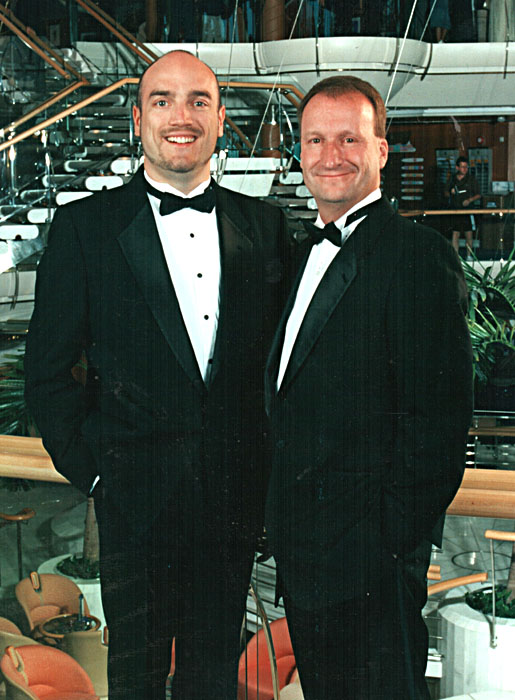
So I bought a tux. My BF rented a tux. And off we went! The night before the Awards were handed out, there was a “nominees reception" where we were given delightful things to eat and drink. They also presented the nominees with their GRAMMY Medallions! All of the nominees get them! It is a brass medal on a blue silk ribbon. It’s very spiffy! They also take our “official” GRAMMY portraits.

The bulk of the awards are given out in a “pre-telecast” ceremony. There are about 125 GRAMMYs given each year; and only about a dozen are presented on the air. My boyfriend’s parents came down for the awards, too. Mom-in-law was kind of excited to see several members of Chanticleer a few seats away.

Well, my category finally came up and, ala,s my GRAMMY went to “Martin Scorsese’s THE BLUES,” which I suspected it would. After my loss at the pre-show we headed over to the Staples Center in Los Angeles to attend the telecast part of the GRAMMYs. After the telecast we went to the big GRAMMY party at the Beverly Wilshire, ate lots, drank lots, picked up our “goody-bags,” and it was over.

I really do wish I’d won. I REALLY want one of those little phonograph-shaped awards! Some day!

Click here to order:


Friday, January 8, 2016

The Wicked Witch does Sondheim

I always find it interesting when my various passions intersect. Such things always pack a little extra fun or satisfaction, despite the difficulties in deciding which collection the thing goes into. The latest cross-pollination is between my Oz collection and my Stephen Sondheim collection.

I have been a Sondheim fan since my early teens. My first exposure to Sondheim was the 1977 film version of A Little Night Music. It is a flawed film, but no where near as awful as legend states. Anyway back to today's blog - I just got a copy of the lovely souvenir program from the National tour of the original Broadway production of the show.

A Little Night Music Souvenir program featuring Boris Aronson's set design.

The handsome program is large and packed with photographs. The Oz connection is that Margaret Hamilton played Madame Armfeldt. It was her final stage role. The tour began February 26, 1974 in Philadelphia and closed February 15, 1975 in Boston.

Incidentally, Hamilton was performing in the tour of Night Music in Los Angeles when she was interviewed by Aljean Harmetz for The Making of The Wizard of Oz (1977).

Madame Armfeldt is an aged demimondaine, a high-end courtesan, (now retired). If you've seen the film Gigi, it was the "occupation" Gigi was being groomed for: a cultured, educated, and lovely woman who would be "kept" in style by an upper-class gentleman - for,.  uhm . . . "favors."

I'm not going to go into the whole plot of A Little Night Music, but you sort of need to know at least that much to understand the song Hamilton sings in the sound clip below.

This is Margaret Hamilton's solo in the show, a song called "Liaisons," in which she recounts her triumphs and losses in love and luxury - and the seeming decline of style, culture, and civilization.


On the one hand, Margaret Hamilton may seem an odd choice for a musical. She does not have a beautiful voice. And in this song she shifts between speaking and singing. But it's a great performance nonetheless. Hamilton did play in at at least two other musicals over the years: as Aunt Eller in Oklahoma! and as Parthy Ann Hawks in Showboat - neither big singing parts.

Below are a few more photos of Hamilton in A Little Night Music.


Thursday, December 13, 2012

I Want to be Seen - GREEN!

I just got an early Christmas present!  A kind friend procured a few small remnants of some extremely Ozzy cloth. Indeed, this handsome stuff was a custom fabric created for the La Jolla production of The Wiz!

I've no idea exactly what I'll do with it. There would just barely be enough for a jacket - and I'm not sure of that. There is certainly enough for a vest - in any case I shall ponder how best to make use of it. While I thought the La Jolla production of The Wiz rather flawed (and often misguided) I am delighted to have a couple yards of this splendid green and gold stuff!

Y'all got it?


Tuesday, July 3, 2012

Where There's a Will There's a Fred

Billie Burke, Fred Stone, and Will Rogers
The American stage humorist Will Rogers, who never met a man he didn't like, was a good buddy of Fred Stone, the superstar originator of the Scarecrow role in the 1903 Broadway Wizard of Oz. In fact, they were so close that Will named one of his sons Fred Stone Rogers. So it's no surprise that an early episode of Will Rogers's radio show featured Fred as a guest. You can listen to that broadcast on Emerald City Radio. During the program Fred and Will sing "Travel, Travel, Little Star," a tune Fred recorded years earlier with his stage partner David Montgomery, who originated the Tin Woodman role in Broadway's Wizard. You can hear the Montgomery and Stone recording of "Travel, Travel, Little Star" on Emerald City Radio, too, and it's included on the Hungry Tiger Press CD Vintage Songs from the 1903 Broadway Wizard of Oz (see the sidebar of this blog to click on the link to order your copy).

The photo above is from 1935 during the production of the movie Doubting Thomas, starring Will Rogers and Billie Burke, who later played Glinda in the 1939 M-G-M film version of The Wizard of Oz. Fred Stone visited Will Rogers on the Doubting Thomas movie set and they both dropped in to see Billie Burke and submit to the obvious photo op.

The Fred Stone episode of the Will Rogers show plays about twice a day for the next week or so on Emerald City Radio. You can also hear the Montgomery and Stone recording of "Travel, Travel, Little Star" as part of our regular playlist.

It's easy to listen to Emerald City Radio on Live365. Just click here to go to Live365 and click "Sign Up" in the upper right hand corner and join for free for access to thousands of internet radio stations. Then "Log In" and make a search for Emerald City Radio. When the Emerald City Radio logo shows up in your search results, just click on the logo to start listening right away! Listening is free.

So give Emerald City Radio a listen. Our current playlist is over 13 hours long with such a wide variety of Oz songs and music that you're sure to hear some old friends and some new delights.

Emerald City Radio - all great, all powerful - all the time! 

Wednesday, April 18, 2012

Jonesing for THE WIZ

One of the more unusual WIZ related items I have is this "promotional" LP recording of an interview with Quincy Jones, the musical supervisor for the movie version of The Wiz (among many other credits). The album was sent out to radio stations in 1978 to publicize the forthcoming film.

The interviewer on the disc is rather lackluster. I suspect the idea was that the local DJ would re-record the questions and make it seem like an actual "local" interview was taking place.

There's some interesting material in the interview - one being how important Jones thought the new song "Is This What Feeling Gets?" was to the score. The song was a rather angry and bitter lament sung by Dorothy in the Emerald City Hotel after the Wiz tells them to go kill Evillene. The song serves as Dorothy's theme and appears as underscoring in the film - including a big swell just as Dorothy returns home in the snow. Yet, by the time the film hit the screen the song was cut. The full song is included on the published soundtrack album.

So now that I've whetted your appetite you can actually listen to the interview which is playing twice daily on Emerald City Radio for the next two weeks.

It's easy to listen to Emerald City Radio on Live365. Just click here to go to Live365 and click "Sign Up" in the upper right hand corner and join for free for access to thousands of internet radio stations. Then "Log In" and make a search for Emerald City Radio. When the Emerald City Radio logo shows up in your search results, just click on the logo to start listening right away! Listening is free.

So come on and give Emerald City Radio a try. Our current playlist is over 12 hours long with such a wide variety of Oz songs and music that you're sure to hear some old friends and some new delights.

Emerald City Radio - all great, all powerful - all the time! 


Friday, March 2, 2012

Nice Package!


Today I got a nice big surprise package in the mail - a box of Ozzy goodness from Japan! It contained a copy of the Japanese program book for the film version of The Wiz, two little picture books of The Wizard of Oz and Ozma of Oz, a theatre magazine with a double-page spread of the Hello Kitty Wizard of Oz musical, and a little tablet of Hello Kitty Wizard of Oz notepaper!

Eric Gjovaag, over at The Wonderful Blog of Oz, suggested to a friend of his that I might be a happy recipient of the Japanese Wiz program -  but I hadn't expected such a neat little treasure bag! Thanks, Eric, and thanks, Michael!


I'm especially pleased with the Hello Kitty stuff - I really want a copy of the Hello Kitty Wizard of Oz DVD from Japan. Anyone? Pretty please?

The sender of this little Ozzy treasure trove has a blog -  My Two Yen Worth - which is much worth checking out. There are several Oz-related blog posts on it, too.

Domo arigato, Jones-San!

Hello Kitty WIZARD OF OZ notepaper!

Saturday, December 17, 2011

Emerald City Radio

We in the Tiger Den are delighted to announce that Hungry Tiger Press has its own internet radio station. And it's available free to all listeners! Our current playlist includes music from almost every Oz musical and Oz film - songs from the 1903 Wizard of Oz on up to the latest Oz hit by Andrew Lloyd Webber.

It's easy to listen to Emerald City Radio on Live365. Just click here to go to Live365 and click "Sign Up" in the upper right hand corner and join for free for access to thousands of internet radio stations. Then "Log In" and make a search for Emerald City Radio. When the Emerald City Radio logo shows up in your search results, just click on the logo to start listening right away! Listening is free.

If you don't want to hear any ads, you can become a Live365 VIP listener. Just click on the banner ad at the bottom of today's blog. It costs a few bucks a month to be a Live365 VIP, but as a VIP you can listen to a wider range of internet radio stations and you'll skip the advertisements.

Emerald City Radio allows a limited number of free non-VIP listeners. So in the slim chance you're kicked off the station or can't connect as a free listener, try again later when there may be fewer listeners. Or convert your account to VIP and you'll never have to leave Live365 unless you want to.

So come on and give Emerald City Radio a try. Our current playlist is over 7 1/2 hours long with such a wide variety of Oz songs and music that you're sure to hear some old friends and some new delights.

Emerald City Radio - all great, all powerful - all the time!  


Wednesday, October 5, 2011

The Scarecrow Goes to College!

In doing much research on the 1903 Wizard of Oz musical for my 2 CD set of Vintage Recordings from the show and my current book project, I have become a fan of Fred Stone who created the role of the Scarecrow. While I have only read of his amazing, amusing, and acrobatic antics on stage, I have seen quite a few of his films from later in his life, and I've got quite a little scrapbook of photos, clippings and odd bits relating to Fred Stone.

One thing I did not have until today was one of his Scarecrow sketches. Occasionally when he signed his autograph he would doodle a Scarecrow. I've seen a dozen or so of these over the years, but either lost out in the bidding, or thought the asking price was too high, but I knew I'd eventually find one.

I'm quite happy with this one. It is large, measuring about 6" x 9" and drawn in pencil which I think adds some subtlety to Stone's drawing. This particular sketch is on the back of a guide book for Knowles Memorial Chapel at Rollins College in Winter Park, Florida dated 1937.

I have not yet deciphered the second autograph. Any guesses?

Thursday, September 15, 2011

I'm Stuck on THE WIZ


A few months ago ago I got an unusual Oz item. I'm not even sure exactly what it is but you can see it at left.

It's a WIZ stick pin. The design of the logo is clearly based on main title logo from the 1978 film version of The Wiz (see poster below). But what exactly is it? Was it sent to movie theaters for ticket-takers to wear? Was it a prize for some Ozzy contest? Was it perhaps a cast and crew gift?

I tend to think it's the latter, but I have no real evidence for such a claim. I have not been able to find anything on the web about such a pin either.

It is very well made. The little gold plunger is heavy and I have wondered if the pin might actually be gold (I have not had it tested) but the casting of the logo is very detailed and the stick itself is very soft and bendable.

As a Wiz fan I'm quite happy to have it - but I'd be delighted to know more about what it actually is, too!


Wednesday, June 29, 2011

Crossover Collectibles

While my interest in Baum and Oz has always been book-focused, I do have a certain fondness for Oz memorabilia from the many stage and screen adaptations. I also like the weird, unusual, and unique sort of Ozzy collectible. The document shown at left is such a thing.

It is a contract between Louis F. Gottschalk and Sam Goldwyn, enlisting the services of Gottschalk to write the score for the 1926 film version of Stella Dallas.

Gottschalk is best known to Oz folk for writing the music for L. Frank Baum's musical comedy The Tik-Tok Man of Oz (1913), the scores to accompany the various Oz Film Manufacturing Company movies, and the music for the abandoned Patchwork Girl of Oz "Children's Theatre" musical. Gottschalk was also a close friend of Baum's during the Hollywood years - both men were instrumental in forming "The Uplifters," a social and theatrical enterprise associated with the Los Angeles Athletic Club.

Sam Goldwyn is the man who bought the film rights to The Wizard of Oz from the Baum family, beginning the process of developing a certain film starring Judy Garland. Goldwyn is also the "G" of MGM.

I really like that this piece of paper connects to otherwise disparate Oz-related names. It's just kind of neat. While the 1926 Stella Dallas film survives, Gottschalk's score seems to have been lost. This film just barely predates sound on film and the score would have been played live in the theatre by either orchestra or organ, depending on the venue.


On a side note, Gottschalk's daughter, Gloria Gottschalk, had a small part in the film. She played one of the Bridesmaids.

If you'd like to hear some of Gottschalk's music you might consider our CD Before the Rainbow - The Original Music of Oz. You can listen to two different suites from The Tik-Tok Man of Oz, as well as all of the themes from the silent film version of The Patchwork Girl of Oz.

Below is a video clip of the marriage scene from the film. I can not tell which Bride's maid Gloria might have been and I do not think the humdrum organ accompaniment is Gottschalk's original score. Still, give it a watch.

Friday, June 24, 2011

Just a Touch of Humbug

Joe Cascone & David Haines
On Saturday July 9, 2011 the Winkie Convention will be honored with a two-man concert from Joe Cascone and his partner, David Haines. Joe Cascone has been Artistic Director of the Toronto Civic Light Opera for thirty-three years (a company he founded at the age of fourteen). A life-long Oz and Baum enthusiast, he wrote the most faithful stage adaptation yet of The Wonderful Wizard of Oz, which premiered in Toronto in 2000. Featuring Joe in the dual roles of Baum and the Wizard, and David as the Cowardly Lion, it has been revived twice so far, in 2002 and 2010, to rave reviews and audience reception, opening the original Oz concept up to new audiences. Joe and David recently co-starred in the Canadian premiere of the off-Broadway hit musical The Big Bang which is now planned for a return engagement next season.

Below is an excerpt from a more lengthy interview with Joe Cascone to be published in the Winkie Convention Program Book.

So how did you get into Oz? Was it from the movie, the books?

My earliest recollection of anything Oz was the Saturday morning Videocraft cartoons, Tales of the Wizard of Oz, which (as a five year old) I found rather entertaining. By the time I had reached the advanced age of six, my parents invited me to watch the annual telecast of the MGM movie, which fascinated (and terrified) me. I most remember being enchanted (and terrified) by it. This first viewing of the classic film (in March of 1970) got me onto a major obsession with all things Oz that lasted throughout my childhood.

Some people who love Oz as a child drift away from it as they enter their teen years and then find it again as an adult. Others stay with it for good.
Nowadays, I think that extreme childhood obsessions are understood better than they were  But once I got to my teens and puberty, etc., I managed to put it into perspective and left it for a while, yet always respecting the profound significance that Oz had on me. As a young adult, I started to reclaim much of my lost childhood collection of Oz memorabilia and regained a strong interest and fascination in it all once again. The Oz stories still affect me deeply to this day.  As an adult, I was amazed to find out how many others shared my experience as children and to hear how Oz has informed their lives and life choices.

Had you long wanted to write a new WIZARD OF OZ musical? How did your collaboration with James Doyle come about?
I had actually written a number of stage adaptations of The Wizard of Oz in the 1980s, one of which we produced in 1986. The only thing it was missing was an original score. I was revising the adaptation in 1999 with the intention of presenting it with a collection of Oz songs from the past century (in anticipation of the Oz centennial) to give it a real “journey” feel. In the course of this, I connected with [David Maxine] who put me onto James Doyle as a resource for uncovering more of the original 1902/03 arrangements. Through our tremendous amount of correspondence, I discovered that James had an on-again-off-again Wizard of Oz project he was working on, an original score for a stage adaptation.  We thus rolled up our proverbial sleeves and decided that this “centennial” production would be our own work, based tightly on Baum’s novel and using only theatrical conceits of the Gilded Age to move it along. It proved to be extremely successful in its premiere production in December of 2000.  James and I were working on revisions to the show for a revival when he died very suddenly and tragically in 2002. I did a number of alterations to the script and score on my own and the show was a hit all over again in December of that year.  More revisions were done for its most recent staging in December of 2010, which proved to be even more successful than the first two times.

What was the biggest challenge in bringing Baum’s WIZARD to the stage? What scene or scenes proved the hardest to pull off or were surprisingly easy?

Theoretically, the hardest part of bringing Wizard of Oz to the stage was to convince everyone involved (and to no small extent the audiences) that this was NOT to be a rip-off of the famous MGM film. This was to be 100% authentic to Baum’s book.  You’d be amazed at how many responses we got to the effect of “There was a book, too?” Onstage, the biggest challenges were the different adventures that Dorothy, the Scarecrow, Tin Woodman, and Cowardly Lion encountered on their journey. While staging a cyclone offers a multitude of exciting artistic opportunities, how does one effectively stage Kalidahs falling into a bottomless pit? Even bigger was the timing standpoint.

David Haines as the Cowardly Lion and Alisa Berindea as Dorothy

If we had let it, the show could have run four hours as we tried to depict every event in the twenty-four chapter novel. The first production was nearly three hours long. In 2002, we had it trimmed to two and a half, and by 2010, it was much tighter at two hours and ten minutes, still telling all the great story. Along the way, we made some compromises and streamlined several adventures into a medley type number called “Further Along the Way,” and we made some omissions as well (the Witch’s wolves, crows, and bees, as well as the whole Quelala and Gayelette backstory). Otherwise, the story is pretty much all there! And in the end, of the thousands of people who saw it, and the many, many people who took the time to write, e-mail, or call in afterwards, there was literally only one dissenting response from an audience member who felt shortchanged at not seeing a retread of the movie.  Not a bad record!

So what’s your favorite Oz book?
How do you choose your favorite child?  Of course, The Wonderful Wizard of Oz is far and away my favorite for its subliminal messages throughout, even though I do believe that Baum didn’t necessarily recognize that they were there as he wrote “solely to pleasure children of today.”  I have much admiration for the excitement he concocts in The Scarecrow of Oz, and I really enjoy the entertaining (if slightly gruesome) prequel aspects of The Tin Woodman of Oz.  For a favorite non-Wizard Oz book, though, I’d have to say Ozma of Oz because of the fun that the story has with revisiting all our friends together again for the first time and in a believable and new scenario.  It also shows us the first time that Baum really took us in the direction of a “series,” even though the book stands alone well, too. 

So how do you feel about coming to your first Oz convention?

I’m actually amazed that it’s taken me this long to get to one.  As a member of IWOC for nearly thirty years, the stars have never quite aligned until now.  I’m very excited at the prospect of connecting with other Ozophiles and experiencing an Oz Con first hand.  And of course performing some wonderful music in our retrospective of the past hundred and ten years of Oz is an exciting and humbling challenge that David and I both hope will be as enjoyable for the audience as it has been for us.